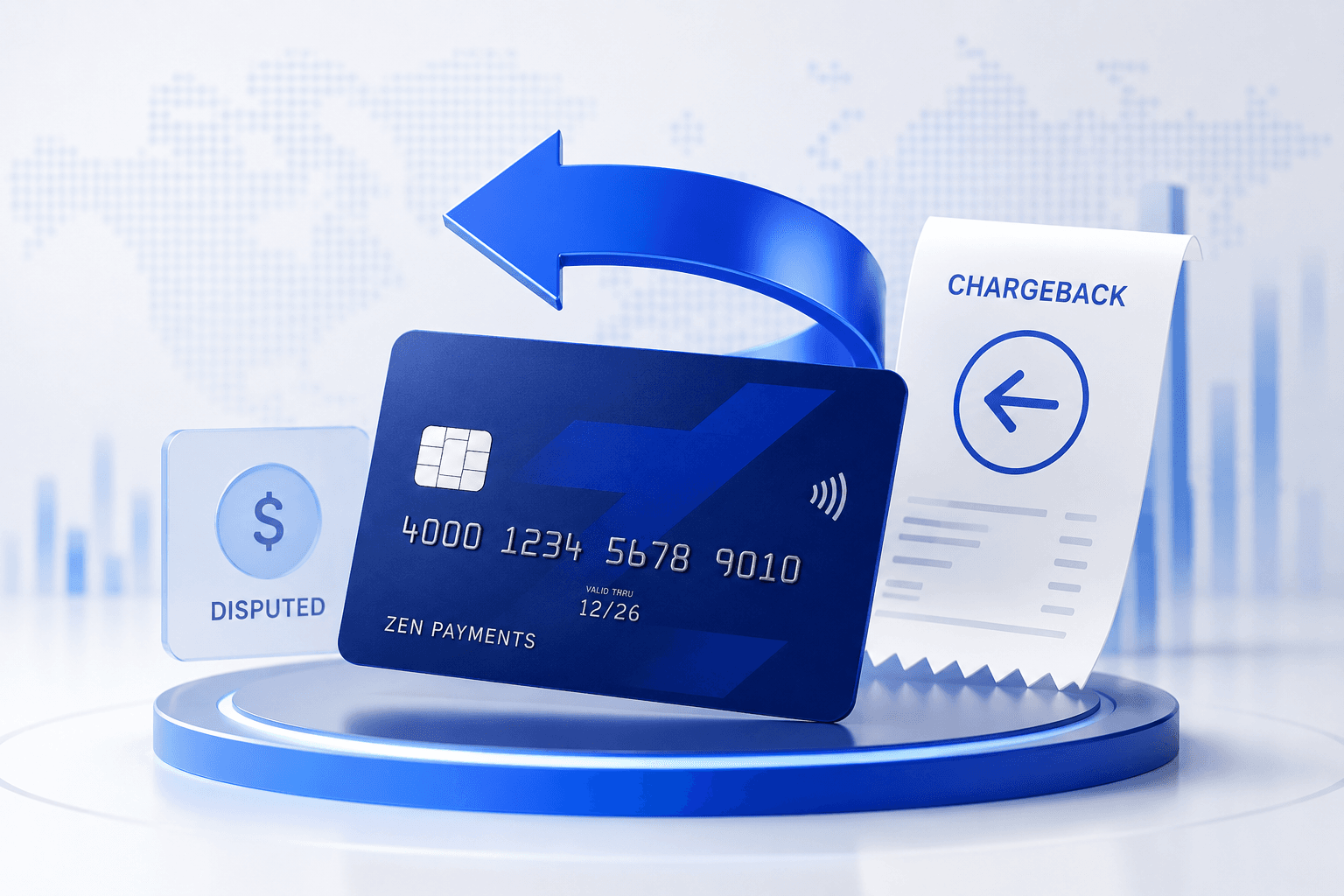
Chargeback vs refund
Chargebacks were created as consumer protection. The Fair Credit Billing Act gives cardholders the right to dispute charges they believe are fraudulent or unfulfilled. That protection is legitimate. The problem is that the system is frequently abused, and merchants bear the cost either way.
Your choice
Refund
You decide to return a customer's money. You initiate it, and it closes the transaction cleanly with no dispute fee against your ratio.
Bank's choice
Chargeback
The cardholder's bank initiates it. Funds are pulled automatically, and you are charged a dispute fee on top of the returned amount, whether you are at fault or not.
How the chargeback process works
Here is what happens from the moment a customer files a dispute to resolution. Card networks publish merchant dispute guidance, including Visa's dispute management guidelines and Mastercard's merchant rules.
01
Customer files a dispute
The cardholder contacts their bank. Common reasons include “I didn't authorize this,” “I never received the item,” or “this isn't what I ordered.”
02
Bank assigns a reason code
The issuer gives the dispute a reason code, provisionally credits the cardholder, and pulls funds from your merchant account.
03
You are notified
Your acquirer or processor notifies you, usually within a few days. Your response window starts immediately. Sometimes this arrives first as a retrieval request asking for transaction documentation—responding quickly can stop a soft inquiry from becoming a hard chargeback.
04
You respond or accept
You typically have 7 to 30 days to submit a rebuttal with evidence. If you don't respond, you automatically lose.
05
Issuer decision
The issuer reviews your evidence and either upholds the chargeback or reverses it back to you (a representment win). Some cases escalate to arbitration with extra fees.
06
Resolution
If you win, funds return to your account. If you lose, the cardholder keeps the money and you absorb the loss plus the chargeback fee.
Common reasons for chargebacks
Chargebacks don't all come from fraud. Understanding the real reason tells you where your exposure is and how to fix it.
Fraud
True fraud
A stolen card was used for a purchase you fulfilled. The real cardholder disputes it. You're out the goods and the funds.
Abuse
Friendly fraud
The cardholder made the purchase, received the product or service, then disputed anyway: forgetting the purchase, buyer's remorse, or exploiting the dispute system.
Fulfillment
Item not received
Claims of never getting what they paid for: lost shipments, wrong addresses, or digital goods that weren't delivered or accessible.
Quality
Item not as described
The product arrived but didn't match the offer: quality disputes, wrong items, or mismatched descriptions.
Recurring
Subscription billing
Customers forget signups, don't expect renewals, or can't find cancel paths. Continuity businesses are especially exposed here. Clear renewal notices and an easy cancel path cut these disputes before they hit the bank.
Timing
Credit not processed
You issued a refund, but the customer disputed before seeing the credit post, or the refund was delayed. A timing problem that creates an unnecessary chargeback.
Chargeback rate thresholds
Your chargeback rate is the percentage of monthly transactions that result in chargebacks. Card networks set hard limits. Exceeding them has escalating consequences. Visa now monitors fraud reports and disputes together under the Visa Acquirer Monitoring Program (VAMP), which replaced older programs such as VDMP.
Visa thresholds
VAMP ratio is (Visa fraud reports + disputes) divided by settled card-not-present transactions. Visa watches acquirer portfolios and individual merchants. Processors often set even tighter internal limits so their own portfolio stays under the acquirer bars.
| Level | VAMP ratio | Minimum monthly events |
|---|---|---|
| Acquirer — Above Standard | 0.50% | 1,500+ |
| Acquirer — Excessive | 0.70% | 1,500+ |
| Merchant — Excessive (U.S., Canada, EU, AP) | 1.50% | 1,500+ |
U.S. merchant Excessive is 1.50% as of April 2026 (it was 2.20% before that). Thresholds and event minimums can vary by region. See Visa's VAMP fact sheet. Once identified, merchants can face per-event fees after a short grace period, and processors may terminate the account.
Mastercard thresholds
| Program | Chargeback rate | Monthly chargebacks |
|---|---|---|
| Excessive Chargeback Merchant (ECM) | 1.5% | 100–299 |
| High Excessive Chargeback Merchant (HECM) | 3.0% | 300+ |
Mastercard's Excessive Chargeback Program can carry monthly fines starting around $1,000 and escalating sharply for HECM merchants.
Being placed in a monitoring program does not immediately end processing, but it starts a countdown. Processors hate that exposure. Stay in a program long enough and many will terminate the account. For how ratios are calculated and what “healthy” looks like, see our guide to chargeback rates.
What a chargeback actually costs
The face value of the transaction is only the beginning.
Fee
Chargeback fee
Typically $20–$100 per dispute from your processor, charged whether you win or lose.
Revenue
Lost transaction amount
Funds are pulled when the dispute is filed. If you lose, they don't come back.
COGS
Product & fulfillment
If you already shipped, you've also lost cost of goods and shipping. Those don't come back either.
Fees
Original processing fees
Interchange and processing fees on the original sale are usually not returned in a chargeback, even if you lose.
Programs
Monitoring fines
Once you're in Visa or Mastercard monitoring, fines can stack monthly and escalate with severity.
Account
Termination & MATCH
Excessive chargebacks can end in termination and MATCH listing, making a new merchant account far harder for up to five years.
How to prevent chargebacks
The most effective chargeback strategy is prevention. Most disputes are avoidable with the right operational practices. For a fuller playbook, see our chargeback protection tactics.
Clear billing descriptor
Use your recognizable business name on the statement. Unclear or abbreviated descriptors drive “I don't recognize this” disputes.
Confirmations & tracking
Send receipts, shipping notices with tracking, and delivery confirmations. Every touchpoint reduces “not received” claims.
Easy support access
If customers can't reach you, their next call is the bank. A visible phone number, email, or live chat feature can interrupt disputes early.
Transparent subscriptions
Remind before renewals, make cancel simple, and state billing terms at checkout. Recurring disputes drop when customers can leave as easily as they signed up.
AVS, CVV & 3-D Secure
Catch stolen-card signals at authorization, and use EMV 3-D Secure where liability shift for fraud chargebacks is worth the friction. See our fraud prevention guide.
Clear refund policy
If customers can see the return policy at checkout, they're more likely to ask you for a refund than dispute with the bank. A refund costs less than a chargeback.
How to dispute and win (representment)
When a chargeback is wrong (the customer did buy, did receive the goods, and is disputing in bad faith), you can fight it. That process is called representment and it is your formal rebuttal with evidence, submitted through your processor to the issuing bank.
Evidence that wins disputes
- Proof of delivery: tracking, signature confirmation, delivery photos
- Order confirmation: receipt sent to the customer's email
- Customer communications: emails or chat showing acknowledgment or agreement
- Terms / refund policy: accepted at checkout
- IP and device data: for digital goods, showing the customer accessed the product
- Photos of the item shipped: matching the product description
Respond within the deadline
Your response window is firm. Miss it and you automatically lose. Windows vary by network and processor, often 7 to 30 days. Route chargebacks to someone who acts immediately.
Why high-risk merchants face higher exposure
Certain industries are structurally more exposed to chargebacks. Card networks still apply the same thresholds, which puts high-risk merchants at a disadvantage.
Industries with elevated rates
 SubscriptionRenewals customers forget or can't cancel easily
 NutraceuticalsBuyer's remorse and effectiveness disputes
 TravelLong gaps between purchase and fulfillment
 FirearmsHigher scrutiny and profile variance
 GamingElevated dispute norms by industry
 CBDRegulation uncertainty and customer hesitation
Mainstream processors often terminate when rates hit internal limits, sometimes below network thresholds. They aren't built to manage high-risk dispute mitigation. High-risk merchants need a processor that understands chargeback rates in industry context, includes dispute tools with the account, won't cut you off the moment you brush a threshold, and helps you lower the rate over time.
Zen Payments works with high-risk merchants who need stable processing through chargeback challenges that would end a relationship at a standard processor.