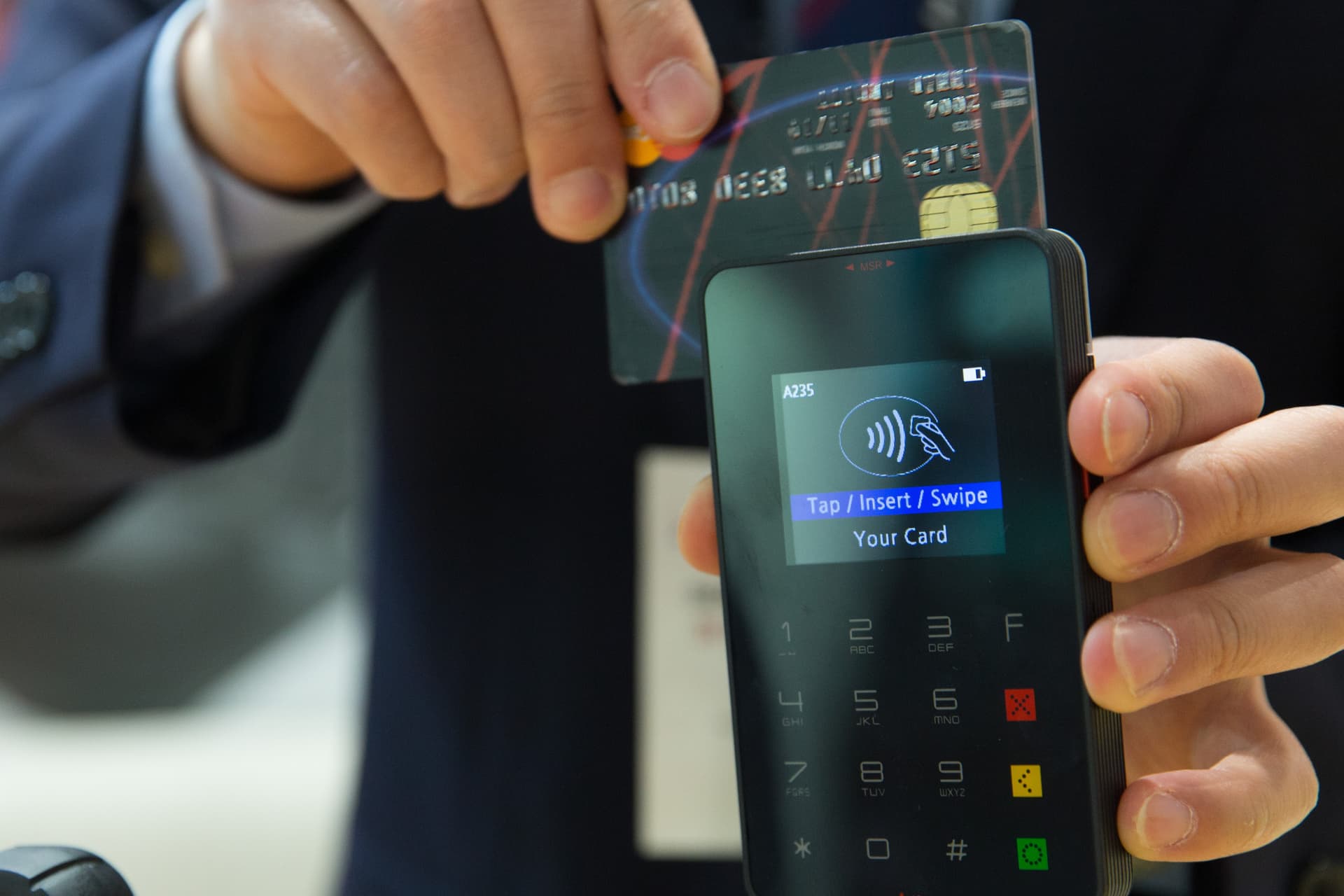
What are credit card processing fees?
Every card payment moves through three parties: the card network (Visa, Mastercard, Amex), the bank that issued the card, and your payment processor. Each takes a cut. Together, those cuts are your credit card processing fees (also called a merchant service fee).
You do not pay those parties separately. Your processor collects everything and passes the network and issuer portions along, which is why statements are hard to read. Understanding the pieces is the fastest way to cut cost without changing how you sell.
Who actually charges you, and what for
Three parties sit behind every approved sale.
Party 1
The issuing bank
The bank that issued your customer's card charges the interchange fee, usually the largest piece of your cost: typically 1.15% to 2.5% per transaction. Card networks set interchange. It does not change with your processor, and you cannot negotiate it.
Party 2
The card network
Visa, Mastercard, Discover, and American Express charge an assessment fee (sometimes called a network fee), usually 0.13% to 0.15% per transaction. Assessments are not negotiable either.
Party 3
Your payment processor
Your processor adds a markup on top of interchange and assessments. That is where quotes differ, and where your statement should be clear. Flat percentage, interchange-plus, or bundled flat-rate all change how easy it is to see what you actually pay.
The three types of fees on every statement
No matter which pricing model you use, statements usually mix these three categories.
1. Transaction fees
Charged on every card sale: interchange + assessment + processor markup. These scale with volume, so they deserve the most attention.
2. Flat monthly fees
Recurring charges that do not depend on volume:
- Monthly account or service fee: $10 to $30/month
- Statement fee: $5 to $15/month
- PCI compliance fee: $5 to $30/month (ask even if you handle PCI yourself). Security requirements are set by the PCI SSC; the monthly fee is a processor charge.
- Gateway fee: $5 to $25/month for a payment gateway
- Terminal or equipment fee: lease or purchase cost for readers and POS hardware
- FANF: Visa's Fixed Acquirer Network Fee, billed monthly or quarterly based on volume, MCC, and locations
3. Incidental fees
Event-based charges that catch merchants off guard:
- Chargeback fee: $15 to $100 per dispute, win or lose
- Retrieval fee: $5 to $20 for bank documentation requests
- NSF fee: when an ACH payment fails for insufficient funds
- Early termination fee: often hundreds to thousands if you exit early
- AVS fee: often $0.01 to $0.05 per address check on keyed or online sales
- ISA fee: Visa's International Service Assessment when a customer pays with a foreign-issued card
The three pricing models
The pricing structure matters as much as the rate. It decides how transparent your costs are, and how easy it is to compare processors.
Most transparent
Interchange-plus
Best for most businesses, especially higher volume. You pay actual interchange plus a fixed processor markup, shown separately on the statement.
Low-risk example: interchange-plus 0.30% + $0.10 on a rewards Visa at 1.80% interchange totals about 2.10% + $0.10. That is a mainstream illustration, not a high-risk quote.
Most simple
Flat-rate pricing
Best for very low volume or merchants who want one predictable number. Aggregators often quote about 2.6% + $0.10 in-person or 2.9% + $0.30 online for low-risk volume. Those rates are not what high-risk accounts are priced at, and they often come with a freeze or shutdown if your vertical does not fit.
Easy to understand, but often costlier when customers use premium rewards cards, because the flat rate is built to cover higher interchange.
How to calculate your effective rate
Your effective rate folds transaction, monthly, and incidental fees into one percentage of volume. Rate is one input when you evaluate a processor, not the whole decision. Funding speed, reserves, contract terms, and whether the account stays open matter as much as the percentage.
Tool
Effective Rate Evaluation
Enter the rate you were quoted, or fees and volume from a statement, to see where you stand.
Enter fees and volume, or a quoted rate, to see where you stand.
A cheaper advertised rate can still cost more if payouts are held or the account is shut down. Compare processors that can actually keep you processing.
Aggregators often quote lower on simple in-person volume. That number is not a target for every business. Card-not-present sales, chargebacks, rolling reserves, and account stability all change what you actually pay. Pull your last three statements and add every line item, not just the per-transaction fees.
Average fees by card type
Not all cards cost the same. These are typical interchange ranges only. Add your processor's markup on top.
| Card type | Typical interchange | Notes |
|---|---|---|
| Visa / Mastercard debit (PIN) | 0.05% + $0.22 | Regulated by Durbin Amendment for large banks |
| Visa / Mastercard debit (signature) | 0.80% – 1.65% | Higher than PIN debit |
| Visa / Mastercard credit (basic) | 1.51% – 1.80% | Standard consumer cards |
| Visa / Mastercard credit (rewards) | 1.71% – 2.40% | Travel rewards, cash back cards |
| Corporate / business cards | 2.20% – 2.65% | Higher due to liability shift |
| American Express | 2.30% – 3.50% | Amex sets its own interchange |
| Card-not-present (online) | Adds ~0.15% to base | Higher fraud risk = higher interchange |
Ranges are general benchmarks and can vary by network program, ticket size, and merchant category. Regulated debit interchange for large issuers is governed by the Federal Reserve's Regulation II (Durbin Amendment). For debit-specific cost and acceptance details, see debit card processing. Corporate and purchasing cards are covered in more depth in B2B credit card processing.
How high-risk businesses are affected
If you operate in a high-risk category, or have been flagged for chargebacks, business model, or credit, fees work differently.
Mainstream processors may decline you outright, or approve you and later terminate with funds held for up to 180 days. In that case your real cost is not just the rate. It is locked-up cash.
Pricing
Higher base rates
High-risk discount rates sit above low-risk aggregator quotes, depending on industry and history, because of the risk the processor absorbs. A cheaper mainstream quote is often not comparable if that account cannot stay open. Some programs also add network registration costs such as the Mastercard high-risk registration fee.
Cash flow
Rolling reserves
Some accounts hold a percentage of volume in a merchant account reserve (often 5-10% for 90-180 days) as protection against chargebacks.
Disputes
More expensive chargebacks
High-risk verticals draw more disputes, and processors often charge higher per-chargeback fees. A spike also counts toward Visa and Mastercard monitoring.
Account
Holds and sudden shutdowns
Mainstream processors may freeze payouts or terminate the account when risk rises. The real cost is lost sales plus cash locked in reserve for months.
How to choose a processor that will still process you
Work through this checklist before you sign. The goal is a durable account with costs you can see, not the lowest advertised percentage. For a longer interview list, use our 20 questions to ask before you sign.
01
Pricing transparency
- Do they offer interchange-plus? If not, why?
- Will they show a full fee schedule in writing before you sign?
- Is there a monthly minimum fee, and what is the threshold?
02
Contract terms
- Is there an early termination fee? How much?
- Is the contract month-to-month or multi-year?
- What happens to your funds if the account is terminated?
03
Support and reliability
- Is support available when you actually need it?
- Do they have experience in your industry?
- What happens if you hit a chargeback spike?
04
Fit for your business
- If you are high-risk, are you with a specialist, not a general provider that merely “accepts” those businesses?
- If you process high volume, does the rate structure reward that? Interchange-plus is often negotiable at scale.
- Confirm whether ecommerce, gateway, or shopping cart tools are included or billed separately.